Songwriting and Coffee 詩書きとコーヒー1 4/24
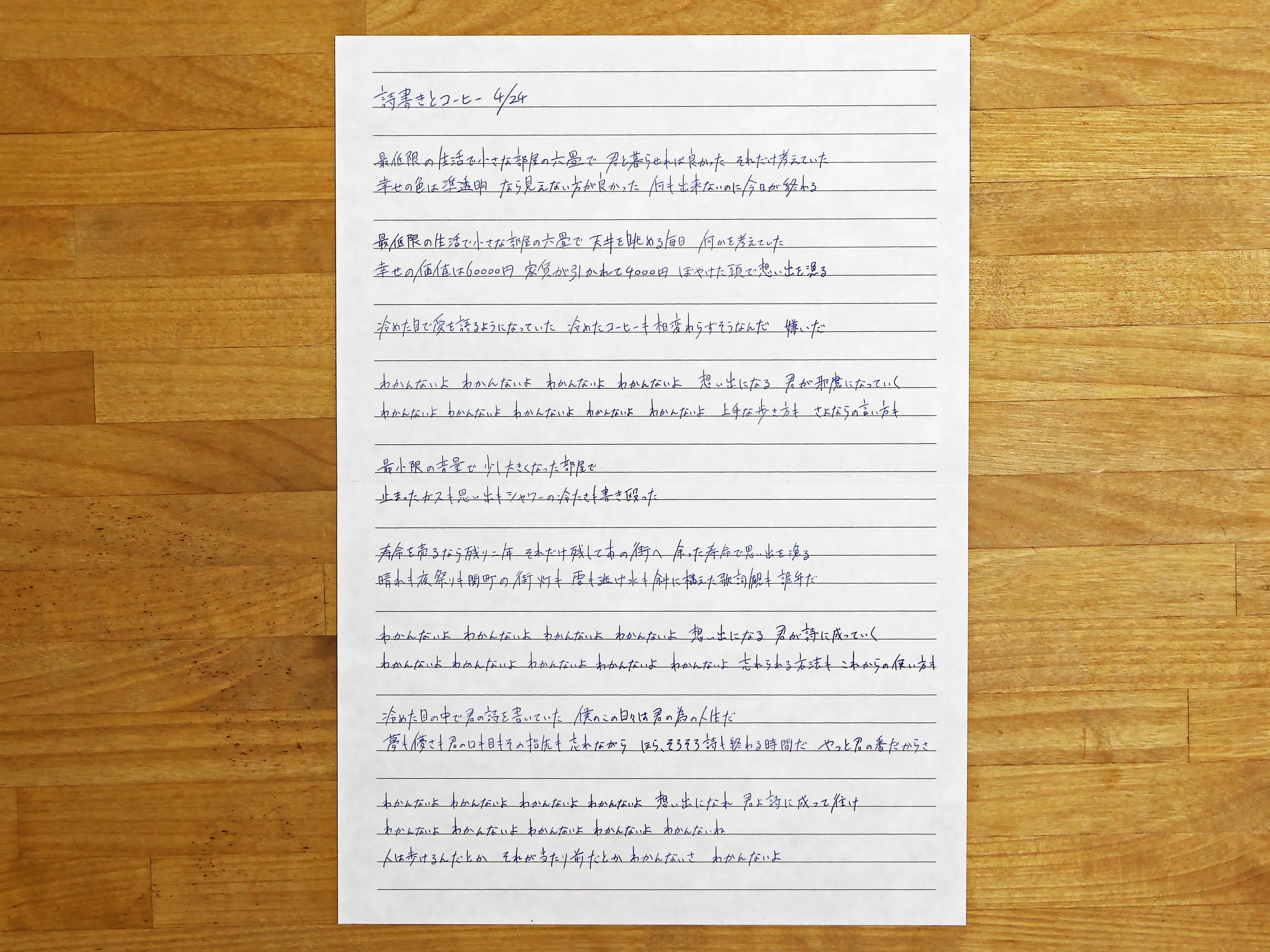
| English | Romaji |
|---|---|
Living at the bare minimum, in a tiny six-mat room2 |
Saiteigen no seikatsu de chiisa-na heya no roku-jou de |
| I thought about how nice it would have been, if only I could've lived with you | Kimi to kurasereba yokatta, sore dake kangaeteita |
| The color of happiness is semi-transparent3, so it was better to be invisible | Shiawase no iro ha jun-toumei, nara mienai hou ga yokatta |
| I can't do anything; still today will end | Nanimo dekinai no ni kyou ga owaru |
Living at the bare minimum, in a tiny six-mat room |
Saiteigen no seikatsu de chiisa-na heya no roku-jou de |
| Every day spent staring at the ceiling, always thinking about something | Tenjou wo nagameru mainichi, nanika wo kangaeteita |
| The value of happiness is 60,000 yen | Shiawase no kachi ha roku-man-en |
| After subtracting rent, 4,0004 | Yachin ga hikarete yon-sen-en |
| With my head in a daze, I rummage through my memories5 | Boyaketa atama de omoide wo asaru |
I got to where I would talk about love with cold and jaded eyes |
Sameta me6 de ai wo kataru you ni natteita |
| And now my coffee, too, is always just as cold | Sameta KO-HI- mo aikawarazu sou nan da |
| I hate this | Kirai da |
I don't get it, I don't |
Wakannai yo, wakannai yo |
| I don't, I don't | Wakannai yo, wakannai yo |
| The memory you've become is beginning to get in my way | Omoide ni naru, kimi ga jama ni natteiku |
| I don't get it, I don't | Wakannai yo, wakannai yo |
| I don't, I don't | Wakannai yo, wakannai yo |
| I don't understand | Wakannai yo |
| The way to walk easily | Jouzu na aruki-kata mo |
| Or the way to say goodbye | Sayonara no ii-kata mo |
At the bare minimum volume, in a room that's become a little bigger |
Saishougen no onryou de, sukoshi ookiku natta heya de |
| The cut-off gas, and my memories | Tomatta GASU mo omoide mo |
| And the cold of the shower - I scribbled them all down | SHAWA- no tsumetasa mo kakinagutta |
| If I were to sell my life, I'd hold back two years | Jumyou wo uru nara nokori ni-nen |
| Keep only that, and go back to that town | Sore dake nokoshite ano machi he |
| With these unneeded years, I rummage through my memories | Amatta jumyou de omoide wo asaru |
Clear days, and festive nights, and the streetlights in Sekimachi7 |
Hare mo yomatsuri mo Sekimachi no gaitou mo |
| Clouds, and heat-mirages, and the cynical slant of my lyrics8 | Kumo mo nigemizu mo sha ni kamaeta kashi-kan mo |
| All sophistry | Kiben da |
I don't get it, I don't |
Wakannai yo, wakannai yo |
| I don't, I don't | Wakannai yo, wakannai yo |
| The memory you've become is beginning to turn to a song | Omoide ni naru, kimi ga uta ni natteiku |
| I don't get it, I don't | Wakannai yo, wakannai yo |
| I don't, I don't | Wakannai yo, wakannai yo |
| I don't understand how to become able to forget | Wakannai yo, wasurerareru houhou mo |
| Or how I could start to do so myself | Kore kara no tsukai-kata mo |
In my cold, jaded eyes, I was writing the song of you |
Sameta me no naka de kimi no uta wo kaiteita |
| All these days of mine, they are a life that's lived just for you | Boku no kono hibi ha kimi no tame no jinsei da |
As I go on forgetting dreams, and transience, and your mouth, and your eyes, and those fingertips of yours |
Yume mo hakana-sa mo kimi no kuchi mo me mo sono yubisaki mo wasure-nagara |
| Listen, the song is coming to its end - it's time | Hora, sorosoro uta mo owaru jikan da |
You see, at long last, your turn has come |
Yatto kimi no ban dakara sa |
I don't get it, I don't |
Wakannai yo, wakannai yo |
| I don't, I don't | Wakannai yo, wakannai yo |
| Become a memory, become a song and then leave me | Omoide ni nare, kimi yo uta ni natte ike |
| I don't get it, I don't | Wakannai yo, wakannai yo |
| I don't, I don't | Wakannai yo, wakannai yo |
| You know I don't | Wakannai ne |
| I don't understand that people can walk | Hito ha arukeru n da to ka |
| Or that that should come naturally to anyone | Sore ga atarimae da to ka wakannai sa |
| I don't understand | Wakannai yo |
- - -
Show/hide footnotes
1 The narrator/songwriter on this album always uses 詩, pronounced as "uta" rather than "shi", when discussing songwriting, and writing lyrics in particular (the word for lyrics (kashi) contains this character: 歌詞). I've also seen two different versions of this song title (the other is 詩書きコーヒー in one place on the official website) but the version here is what's used most often.
2 A "six-mat room" is a common layout of tatami floor mats for rooms or very small apartments. It comes out to an area of around 10 m2 (110 ft2), with dimensions of around 3.6m x 2.7m (12 ft x 9 ft). Tatami mat measurements are used to describe and define common room sizes in Japan even when the rooms don't actually have tatami flooring.
3 Calling back to the earlier Yorushika song "Semi-Transparent Boy" (準透明少年). In that song, the singer feels he is invisible (transparent) to everyone and is performing in the hopes of being seen, but after becoming inspired by a peer's singing, he comes to understand that he imagines color and form within himself through his interpretation of others, even if that doesn't make others acknowledge him. Therefore he can only truly be "semi"-transparent.
4 In 2019, 60,000 yen would have been about $550 USD, with 4,000 yen being around $37 USD.
5 想い出 here and throughout the album, a less standard spelling that emphasizes the strong emotions tied to the memory.
6 Playing on 冷めた目 (sameta me) "cold look" and 目が覚めた (me ga sameta) "awake" or "having come to one's senses".
7 Sekimachi is a neighborhood in the Nerima Ward of Tokyo.
8 This constructed phrase is likely a play on the common word 価値観 (kachikan), one's values.