In May, From the Paris Green Windowsill 5/15
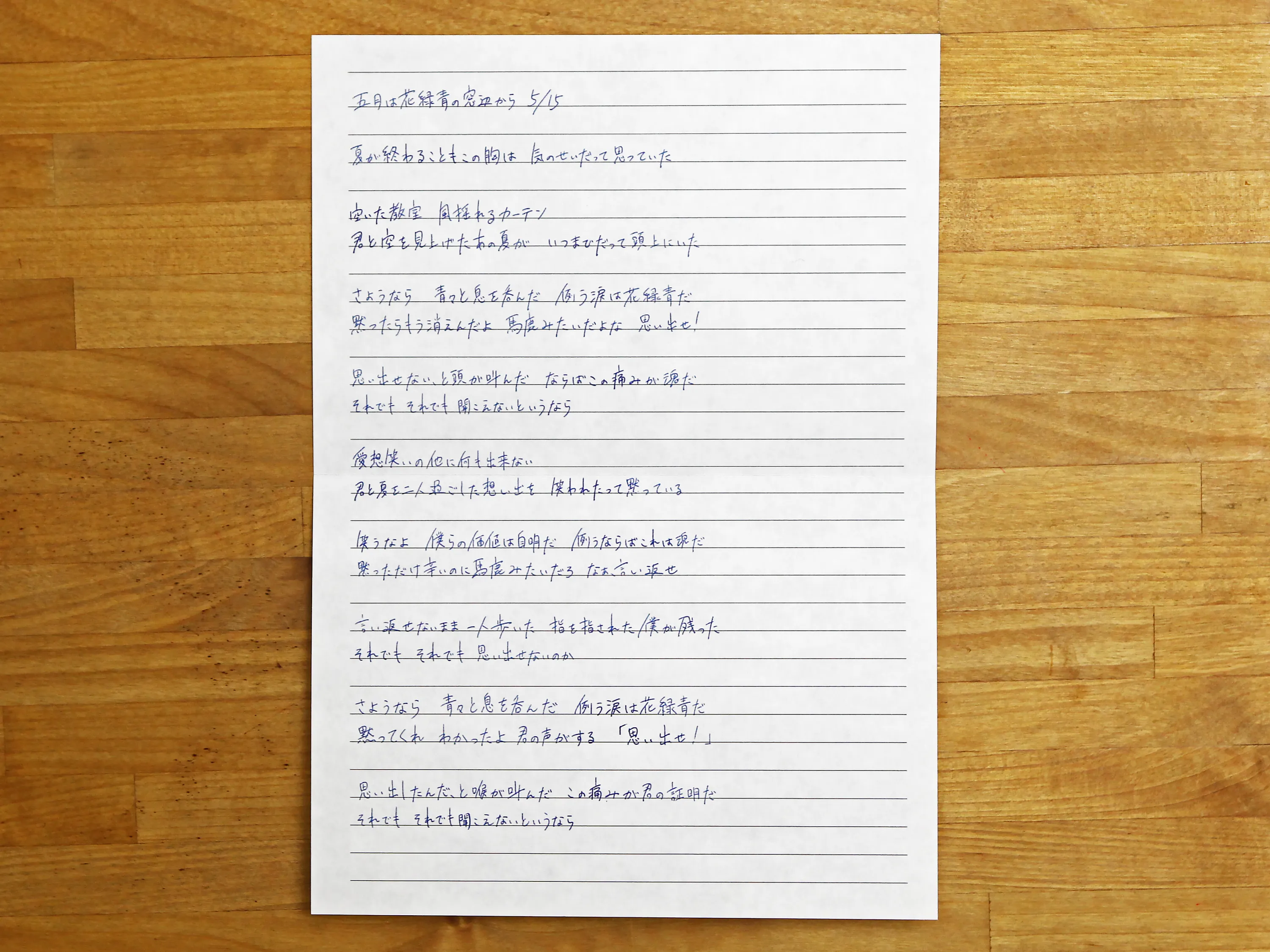
五月は花緑青の窓辺から1
| English | Romaji |
|---|---|
In my heart, I thought I was only imagining |
Natsu ga owaru koto mo kono mune ha |
| That the summer would come to an end | Ki no sei da tte omotteita |
The classroom sitting empty, the curtains swaying in the breeze |
Aita kyoushitsu, kaze yureru KA-TEN |
| That summer spent gazing up at the sky, together with you | Kimi to sora wo miageta ano natsu ga |
| It's lived above my head ever since | Itsu made datte zujou ni ita2 |
Goodbye |
Sayounara |
| The sigh held in my throat was deep blue; tears, I would compare instead to Paris green | Aoao3 to iki wo nonda, tatou4 namida ha hanarokushou da |
| If I don't say something, I'll disappear | Damattara mou kien da yo |
| It's absurd, don't you think? | Baka mitai da yo na |
Remember! |
Omoidase! |
But I can't remember!, is what my mind screamed out |
Omoidasenai, to atama ga sakenda |
| So then this pain that I feel must be my soul | Naraba kono itami ga tamashii da |
| But even still, but even still, you say you can't hear me at all | Soredemo, soredemo kikoenai to iu nara |
I can't do anything at all besides forcing polite smiles |
Aisowarai no hoka ni nanimo dekinai |
| The precious memories of the summer that I spent together with you | Kimi to natsu wo futari sugoshita omoide5 mo |
| Even if people laughed, I wouldn't speak up | Warawaretatte damatteiru |
Stop laughing! We were worthwhile, anyone could see that |
Warau na yo, bokura no kachi ha jimei da |
| If I had to compare, I'd say this is my soul | Tatou naraba kore ha tamashii da |
| It's so difficult to just say nothing; absurd, right? | Damatta dake tsurai no ni baka mitai daro |
| Come on, tell them! | Naa, iikaese |
But I just couldn't; I walked on alone |
Iikaesenai mama hitori aruita |
| Fingers were pointed at me, only I remained | Yubi wo sasareta boku ga nokotta |
| But even still, but even still, can you not remember? | Soredemo, soredemo omoidasenai no ka |
Goodbye |
Sayounara |
The sigh held in my throat was deep blue; tears, I would compare instead to Paris green |
Aoao to iki wo nonda, tatou namida ha hanarokushou da |
| Don't say any more, I get it now | Damatte-kure, wakatta yo |
| It's your voice that I hear | Kimi no koe ga suru |
"Remember!" |
"Omoidase!" |
I remember now!, is what my throat screamed out |
Omoidashita n da, to nodo ga sakenda |
| This pain I feel is the proof that you were here | Kono itami ga kimi no shoumei da |
| But even still, but even still, you say you can't hear me at all | Soredemo, soredemo kikoenai to iu nara |
- - -
Show/hide footnotes
1 花緑青 (hanarokushou) is the Japanese name given to the color Paris green, an arsenic-based pigment that's infamous for its toxicity. 緑青 by itself refers to verdigris, the blue-green patina that forms on copper. The 花 prefix means "light blue" (cf. 花色).
2 The animate existence verb "iru" is used here for the inanimate subject "summer", giving it a sense of life or personhood. The verb tense here is also unusual; "itsu made datte" refers to an extension of time into the unknown future, a "forever", but the verb "ita" is in the perfect tense, placing the whole structure, from start to end, in the past. This could just be part of the "narrative" past-tense, but I've chosen to interpret it in a present and ongoing sense.
3 青々 (aoao) refers to intense shades of both green and blue, historically considered the same color in Japanese. Given that the color blue is a common motif throughout the album, and given the comparison with Paris green, I chose to use "blue" here.
As a secondary note, this is probably a reference to the phrase 青息吐息 (ao-iki-to-iki), which indicates being deeply troubled or distressed; in that context 青 potentially refers to the "bluish" pallor of someone who's unwell or in pain, as it does in 青ざめる (aozameru, "to turn pale").
4 例う (tatou) is a literary/archaic rendering of 例える (tatoeru), sharing the same meaning and usage. The narrator enjoys using similar throwbacks elsewhere in the album's supplementary materials, particularly 伝う (valid in its own right, but also a version of 伝える).
5 想い出 here and elsewhere in the album, a less standard spelling that emphasizes the strong emotions tied to the memory.